
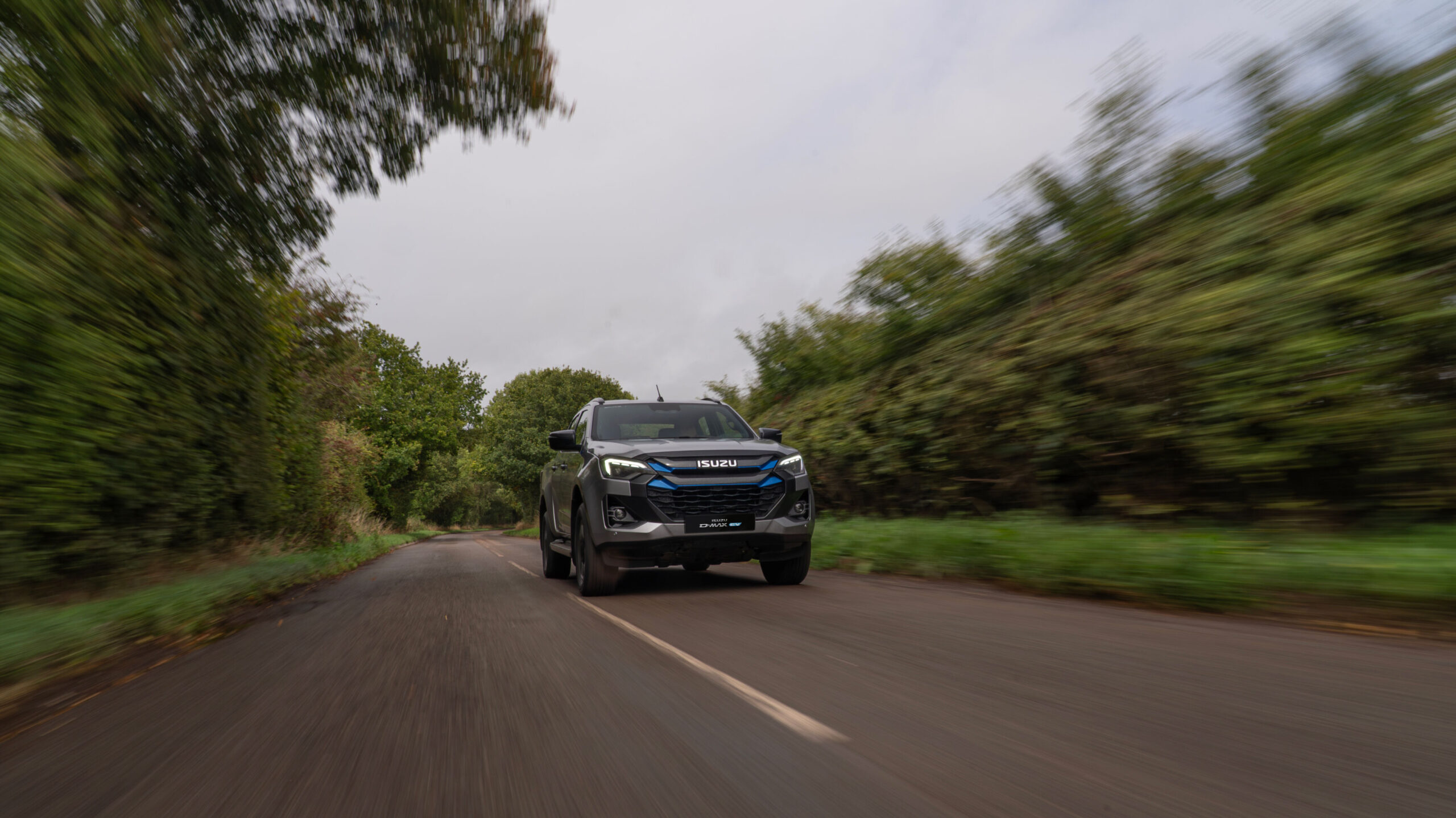
- National Grid Electricity Distribution (NGED) becomes one of the first UK organisations to trial the D-Max EV.
- Eight NGED field engineers will test the D-Max EV across challenging environments and terrain, contributing to its development.
- The partnership marks a major step in delivering a fully electric and fully capable 4×4 pick-up with the commercial reliability customers expect.
Isuzu UK has entered into a strategic collaboration with National Grid Electricity Distribution (NGED) to test and refine the forthcoming D-Max EV ahead of its market launch in early 2026. NGED, one of the UK’s largest electricity distribution network operators, will deploy eight designated field operations engineers to put the D-Max EV through real-world operational conditions across its Midlands, South Wales and South West regions.
The trial follows four years of close collaboration between NGED and Isuzu, led by NGED’s Fleet Technical Specialist, Jane Nicholson. She and her team have met Isuzu’s design groups in Japan and Europe, feeding in operational requirements and converter input to integrate storage and equipment solutions tailored for utility fieldwork.
Fleet Technical Specialist at NGED, Jane Nicholson, said: “Isuzu has been very keen to have our input from the start, and we’ve met their design teams from Japan and Europe many times, providing them with detailed information on the business’s requirements. This led to us having the opportunity to design and build a D-Max alongside specialist vehicle converters Strongs, with our engineers providing input into the features and storage solutions that will make the biggest difference to their work, carrying out upgrades and repairs to the electricity network. We’ve always trialled EV vehicles before deploying them into the business, but never to the extent that we are doing with the Isuzu D-Max EV, which will have off-road capabilities and the ability to tow and winch.”
NGED has one of the UK’s largest and most diverse fleets and is increasingly switching to cleaner fuel sources to run them. It has 1,200 EVs comprising 400 commercial vehicles and 800 cars. The company has a strong record of working with manufacturers and specialists to develop vehicles, having previously partnered with Strongs to convert a passenger car into a light commercial vehicle with all-terrain capability.
Transport Manager at NGED, Chris Mayell, added: “This is a unique chance to shape not just the vehicle itself but the way it’s fitted out for the demands of our fieldwork. Ultimately, we hope it will also be another important step forward in our ambition to have a decarbonised fleet.”
An NGED technician based in Cornwall, David Cassidy, commented: “Isuzu and Strongs were upfront about what features could be included, and clear about the trade-offs too, like payload versus battery size. The vehicle itself feels impressively like our current diesel models, which makes the transition easier. I’m feeling genuinely excited about trialling the EV in daily work.”
An NGED technician based in Cardiff, Richard Gadd, added: “I’ve enjoyed exploring the 4×4’s capabilities both on and off-road, getting to see the hard work and technology that’s gone into the vehicle, and the experience of connecting sustainability with real-world challenges.”
The New D-Max EV marries zero-emission electric drivetrain technology with the proven capability of Isuzu’s 4×4 pick-up architecture. Key specifications include:
- Dual-motor full-time 4WD system,
- 140 kW total power output and 325 Nm torque,
- 66.9 kWh lithium-ion battery pack,
- 3.5-tonne towing capacity,
- 1 tonne payload,
- 210 mm ground clearance,
- 600mm wading depth,
- 30.5° approach angle and 24.2° departure angle.
These specifications confirm the D-Max EV offers the industry-first combination of zero-emission driving with genuine 4×4 off-road, tow, and load capability, making it particularly suited to demanding utility, fleet and commercial applications.
Mark Hayes, Fleet Sales Manager at Isuzu UK, commented: “We are very proud to work alongside National Grid Electricity Distribution on this critical development phase of the D-Max EV. Their frontline field-engineering expertise and insights are invaluable to ensuring the vehicle is truly fit-for-purpose for utility fleets. The D-Max EV is engineered to deliver uncompromised capability, whether that’s towing, loading, off-road access or endurance, while enabling our fleet customers to take a bold step into zero-emission operation. Trials like this make certain we bring to market a vehicle that not only runs clean but also performs without compromise.”
To learn more about The New Isuzu D-Max EV, visit www.isuzu.co.uk/electric-pickup.