
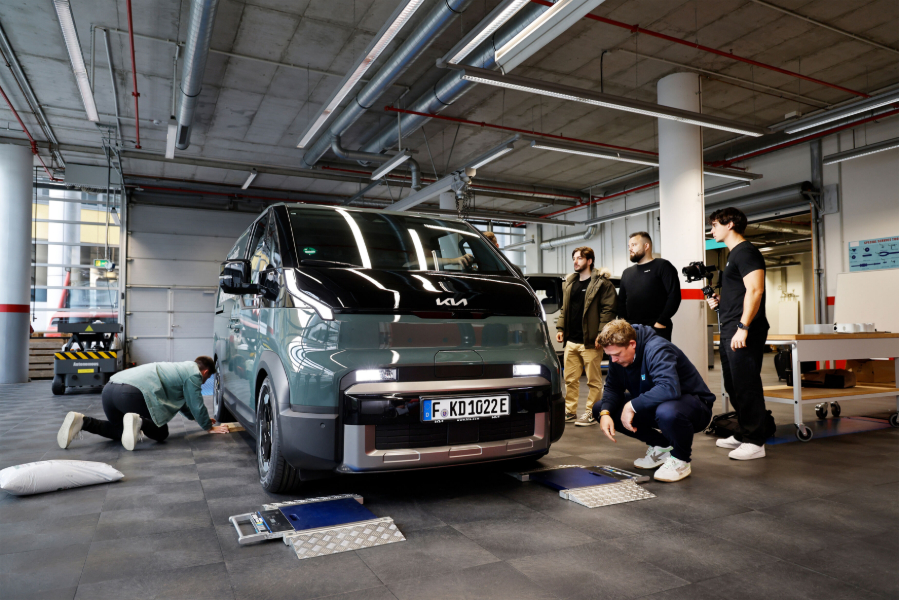
- The Kia PV5 Cargo sets a Guinness World Record for electric light commercial vehicles (eLCVs)
- The model travelled 693.38km (430.84 miles) on a single charge while carrying its maximum payload*
- The achievement highlights the efficiency, flexibility, and real-world practicality of Kia’s first Platform Beyond Vehicle (PBV)
- Record set by George Barrow, a respected commercial vehicle journalist, and Christian Nigemeier, a senior engineer at Hyundai Motor Europe Technical Centre
Kia has made history, setting a new global benchmark for all-electric range (AER). The Kia PV5 Cargo, the company’s first dedicated electric light commercial vehicle (eLCV) and part of its pioneering Platform Beyond Vehicle (PBV) line-up, has officially entered the Guinness World Records™ for achieving:
“The greatest distance travelled by a light-duty battery-powered electric van with maximum payload on a single charge is 693.38km (430.84 miles)”.
Fully loaded with its maximum permitted payload*, the PV5 Cargo L2H1 71.2kWh covered 693.38 kilometres (430.84 miles) on a single charge, setting a new benchmark for efficiency and endurance in the eLCV segment. The record-breaking drive took place on 30 September 2025 under authentic, real-world conditions on public roads north of Frankfurt, Germany.
“Even if Kia is new to the LCV market, this record is a testament to the versatility and innovation behind Kia’s first PBV, showing that we are serious contenders.” said Marc Hedrich, President and CEO of Kia Europe. “The fact that much of our target audience for this van variant could operate for almost two full working days on a single charge speaks volumes about its real-world capability. The PV5 combines efficiency, flexibility, and intelligent connectivity in one package.”
AER record proves the Kia PV5’s everyday practicality
The record route was carefully designed to replicate the daily realities of delivery and logistics operations. Over a 58.2 kilometre urban and extra-urban loop, the PV5 Cargo faced traffic lights, intersections, roundabouts, and typical city traffic — mirroring the conditions most fleet drivers encounter every day. On top of this, the van repeatedly tackled an elevation gain of approximately 370 metres, completing the loop 12 times while carrying its full payload, and finally coming to a stop within the twelfth loop. These demanding conditions highlight the PV5 Cargo’s exceptional efficiency and reliability, making it an outstanding companion for sustainable urban mobility.
Engineers have specifically optimised the PV5 to maximise practical usability without compromise. Internal tests show that an additional 100kg of payload reduces the PV5’s range by only around 1.5%, establishing it as an exceptionally efficient and dependable option for commercial operators.
The heroes behind the wheel
At the wheel of the record-setting PV5 were George Barrow, a respected commercial vehicle journalist who specialises in vans and Christopher Nigemeier, a senior engineer at the Hyundai Motor Europe Technical Center (HMETC). The award-winning journalist has more than 15 years of experience covering LCVs. He has also been on the jury of International Van of the Year (IVOTY) Award since 2016, representing the UK. Nigemeier, holds degrees in mechanical engineering and has been part of the PV5 development team.
“I’m genuinely excited to have been part of this incredible Guinness World Records achievement. It was a demanding but unforgettable journey,” said Barrow. “I was seriously impressed by how far the Kia PV5 can go: more than 430 miles on a single charge and with a full payload. That’s no small feat, and I have a feeling this record won’t be easy to beat! The PV5 and Christopher were great teammates for this challenge, and I’m proud to have been part of a record that pushes the boundaries for electric vans.”
“As an engineer, this challenge was both technical and personal,” said Christopher Nigemeier, Senior Engineer at Hyundai Motor Europe Technical Center. “George brought an incredible amount of driving experience from testing other vans, while I had the advantage of knowing the PV5’s powertrain inside out. It became a friendly competition between us – who could squeeze the most out of each kilowatt-hour. In the end, it was the vehicle itself that impressed us both.”
The record attempt was meticulously prepared. Inspectors from TÜV Hessen and buck Vermessung supervised the loading process and verified compliance with weight specifications. The drive was continuously recorded using GPS tracking and in-cabin cameras. Before departure, the PV5’s battery was charged to 100% and both the charging port and cargo compartment were sealed until the end of the 22-hour, 30-minute journey.
The first member of Kia’s flexible PBV family
As the inaugural model in Kia’s PBV family, the PV5 is built on the innovative E-GMP.S architecture (Electric-Global Modular Platform for Service) and designed with a modular “building block” concept. This flexibility allows for multiple configurations – Cargo, Passenger, Chassis Cab, Crew Van**, Wheelchair Accessible Vehicle, and light Camper** – to suit a wide range of commercial and personal applications.
The PV5 Cargo L2H1 variant offers up to 4.4m3 of load space*** and a payload capacity of up to 790kg****. Customers can choose from two battery options – 51.5kWh or 71.2kWh – tailored to their operational needs.
With this Guinness World Record, Kia underscores its ongoing commitment to developing innovative, efficient, and practical solutions for the mobility of tomorrow. The record-breaking Kia PV5 Cargo will be on display at the Solutrans Tradeshow in Lyon (EurExpo) from 18 November 2025, Hall 5, Booth C130.