• Kinetiz claims inaugural title by just 4 points, beating out rival TUM for top spot
  • All teams demonstrated significant technical progress in driving algorithm development
  • A2RL governance tested by ingenuity, leading to a much-evolved ruleset for November’s real-world finale

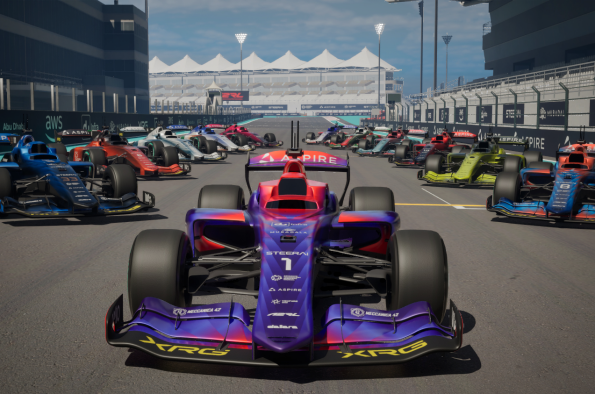
Abu Dhabi, UAE- 24, Sep 2025: The inaugural A2RL SIM-Sprint series has concluded after its fourth race, with Kinetiz claiming overall victory. The virtual autonomous racing series pushed the teams’ AI drivers to the limit at three different racetracks, including Suzuka, Yas Marina Circuit, and a unique, purpose-built virtual track, Autonodrome.

The Kinetiz team finished with 78 points, narrowly beating rival – and A2RL Season 1 winner – TUM by just 4 points. Unimore Racing and PoliMOVE rounded out the top four, separated by just one point. They were followed by Constructor Racing and TII Racing.

Accelerated technical development
A2RL SIM-Sprint series with four races was created to accelerate the development of driving algorithms and refine sporting regulations ahead of the real-world A2RL race on 15 November 2025. The four virtual races provided teams with a broad range of challenges and “edge cases” to push their algorithms to the limit in a safe and accessible environment. This has set them up for greater success in November, when their algorithms will pilot the EAV-25 autonomous racecars at up to 300km/h around Yas Marina Circuit.

Governance: Teams’ lateral thinking tests evolving ruleset 
Over all four races of A2RL SIM-Sprint, teams continued to embrace the motorsport mindset of proactively identifying gaps in the ruleset to deliver competitive advantage. From cutting corners to collisions, the teams tested – and broke – the newly-created governance system. For example, the final round saw penalties imposed for collisions and real-time investigations by the stewards. There were also official protests and reviews of a notable incident between Kinetiz and TUM, requiring fair and analytical consideration of a high-stakes decision.

Over the course of A2RL SIM-Sprint, the ruleset evolved through five different iterations, mitigating potential issues and promoting fairness. This evolution was grounded in the “spirit” of the competition and racing with respect, a factor that will be even more important for the real-world race in November.

Alexander Winkler, Head of Sporting at A2RL, commented: “We are extremely proud of A2RL SIM-Sprint; it has been an immense success, and certainly not without its challenges. From the outset, we had to build a world-class autonomous racing simulation platform, secure team engagement, and launch an all-new virtual competition. The result was a robust and fiercely competitive series that has become a genuine reference point for A2RL’s future, accelerating both AI development and our sporting framework. Congratulations to Kinetiz and all participating teams for the remarkable progress made across the four rounds.”

Stephane Timpano, CEO of ASPIRE (the organizers of A2RL), commented: “The team at A2RL have done a fantastic job in building SIM-Sprint from the ground up in mere months. It has enabled the level of competition to grow sharper and better prepared the teams for wheel-to-wheel action around Yas Marina Circuit in November. Congratulations to all the teams involved for approaching this new competition with an open mind and exceptional engineering creativity – together we are pushing the boundaries of autonomous technology.”

Images of SIM-Sprint are available to download here: https://we.tl/t-aDNIqTlDKn
Images of A2RL Season 2 are available to download here: https://we.tl/t-crQOlJxaoT
A race recap video from Head of Sporting, Alex Winkler is available here: https://youtube.com/shorts/X0bPjQZMErg?feature=share

By admin

Leave a Reply

Your email address will not be published. Required fields are marked *

You missed

South West homeowners face seven-day waits for urgent repairs as tradie shortages continue to bite Fix Radio analysis shows the South West is among the slowest regions for urgent fixes, while Plymouth records one of the longest city-level waits in the UK The South West records an average 7-day wait for an urgent tradie fix. Plymouth records one of the longest city-level waits in the dataset, at 10 days. Across the 17 cities surveyed, the average wait for an urgent fix is just over 6 days. CITB says the UK construction industry needs to recruit the equivalent of 239,300 extra workers between 2025 and 2029. Analysis from Fix Radio shows that homeowners in the South West are facing an average seven-day wait for an urgent tradesperson fix, placing the region among the slower parts of the UK for repair response times. Based on Fix Radio’s analysis of city-level urgent repair wait-time data from Markel Direct’s Censuswide survey of UK homeowners, the findings point to continued pressure on trades capacity, local demand and labour availability across the region. The national picture remains highly uneven. The East of England records the shortest average wait at three days, followed by the North East on four days, the North West on 4.5 days and London on five. Wales and the South East each average six days, Yorkshire and the Humber sits at 6.5, while the South West, West Midlands, Scotland and Northern Ireland all come in at seven days. At the other end of the scale, the East Midlands records the longest average delay at nine days, leaving a six-day gap between the fastest and slowest regional averages in the dataset. The research also found that 44% of homeowners have already delayed repairs because of the cost of hiring a tradesperson, while city-level data shows waits stretching as high as 10 days in Plymouth for urgent issues. That makes the South West one of the clearest examples of how regional pressure can build when local demand, household repair needs and labour constraints begin to overlap. Set against a construction workforce already under strain, the figures point to a region where availability remains a growing issue for both customers and tradespeople. CITB forecasts that the industry will need to recruit the equivalent of 239,300 extra workers between 2025 and 2029, with the UK construction workforce expected to reach around 2.75 million by 2029. From Fix Radio’s perspective, the findings reflect a wider story around availability, local demand and the challenge of keeping enough skilled people in the pipeline. Waiting times are not only a sign of homeowner frustration. They also show where order books are full, where capacity is tight and where the wider conversation around skills and recruitment is becoming harder to ignore. In the South West, where regional averages are already above the national benchmark and Plymouth stands out as one of the slowest locations in the dataset, that pressure is becoming increasingly visible. About Fix Radio Fix Radio, the Builders Station is the home of entertainment, music and information for UK tradespeople. Since 2017 the station has been built from the ground-up with tradespeople in mind, providing a mixture of authentic trade voices, up-beat music and a schedule designed around the tradesperson’s day. The station’s schedule includes some of the biggest talent in the industry, including social media influencers the Bald Builders, Clive Holland of the BBC and formerly Cowboy Trap, the country’s most famous plasterer Chris Frediani from DIY SOS, plumbing influencers Andy Cam and Todd Glister, decorators Joel Bardall and Todd Von Joel, electrician turned YouTuber Thomas Nagy, Roofer of the Year Danny Madden, carpenter, craftsman and social media influencer Robin Clevett. Broadcasting nationally on DAB since May 2022, Fix Radio has an average reach of 833,545 tradespeople each week. The Builders Station also boasts 27.9 average weekly listening hours. Fix Radio’s audience reach and listening hours are audited by Nielsen.