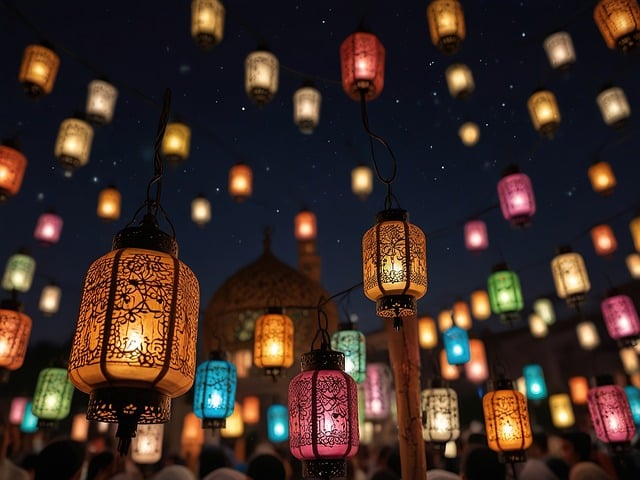
Eid is an Arabic word that means “festival” or “celebration.” There are two main Islamic holidays known as Eid in the Islamic calendar:

  1. Eid al-Fitr: This is the festival of breaking the fast. It marks the end of Ramadan, the holy month of fasting observed by Muslims worldwide. Eid al-Fitr is celebrated with prayers, feasting, giving of gifts, and charity.

  2. Eid al-Adha: Also known as the Feast of Sacrifice, Eid al-Adha commemorates the willingness of Prophet Ibrahim (Abraham) to sacrifice his son Isma’il (Ishmael) as an act of obedience to God. However, before the sacrifice could be carried out, God provided a ram to sacrifice instead. This festival coincides with the Hajj pilgrimage in Mecca and involves the sacrifice of an animal (usually a sheep, goat, cow, or camel) in commemoration of Ibrahim’s obedience.

Both Eid al-Fitr and Eid al-Adha are important occasions in the Islamic calendar and are marked by prayers, special foods, and time spent with family and friends.

The celebration of Eid varies depending on cultural traditions, but there are some common practices observed by Muslims around the world:

  1. Prayers: Muslims start the day by attending special Eid prayers, which are typically held in mosques or large open spaces. These prayers are usually performed in congregation and are an integral part of the Eid celebration.

  2. Greeting: After the prayers, people exchange greetings by saying “Eid Mubarak,” which means “Blessed Eid.” This is often accompanied by hugging, handshakes, and well-wishing among family members, friends, and neighbors.

  3. Charity: Giving to those in need is an essential aspect of Eid celebrations. Muslims are encouraged to give Zakat al-Fitr, a form of charity given before the Eid prayers, to ensure that everyone can participate in the festivities. Additionally, many people engage in acts of charity and generosity throughout the day.

  4. Feasting: Eid is a time for indulging in delicious food and sweets. Families often prepare special dishes and desserts for the occasion, and it’s common to invite friends and relatives over for a festive meal.

  5. Dressing up: Many Muslims wear new or their best clothes on Eid, symbolizing a fresh start and a celebration of the occasion. It’s also customary for people to adorn their homes with decorations and lights.

  6. Visiting: Eid is a time for gathering with loved ones, so visiting friends and family members is a common practice. People often travel long distances to be with their relatives during this special time.

  7. Gift-giving: Exchanging gifts is a cherished tradition during Eid, especially among family members and children. It’s a way to express love, appreciation, and gratitude.

Overall, Eid is a joyous occasion filled with prayer, reflection, generosity, and communal celebration.

By admin

Leave a Reply

Your email address will not be published. Required fields are marked *

You missed

South West homeowners face seven-day waits for urgent repairs as tradie shortages continue to bite Fix Radio analysis shows the South West is among the slowest regions for urgent fixes, while Plymouth records one of the longest city-level waits in the UK The South West records an average 7-day wait for an urgent tradie fix. Plymouth records one of the longest city-level waits in the dataset, at 10 days. Across the 17 cities surveyed, the average wait for an urgent fix is just over 6 days. CITB says the UK construction industry needs to recruit the equivalent of 239,300 extra workers between 2025 and 2029. Analysis from Fix Radio shows that homeowners in the South West are facing an average seven-day wait for an urgent tradesperson fix, placing the region among the slower parts of the UK for repair response times. Based on Fix Radio’s analysis of city-level urgent repair wait-time data from Markel Direct’s Censuswide survey of UK homeowners, the findings point to continued pressure on trades capacity, local demand and labour availability across the region. The national picture remains highly uneven. The East of England records the shortest average wait at three days, followed by the North East on four days, the North West on 4.5 days and London on five. Wales and the South East each average six days, Yorkshire and the Humber sits at 6.5, while the South West, West Midlands, Scotland and Northern Ireland all come in at seven days. At the other end of the scale, the East Midlands records the longest average delay at nine days, leaving a six-day gap between the fastest and slowest regional averages in the dataset. The research also found that 44% of homeowners have already delayed repairs because of the cost of hiring a tradesperson, while city-level data shows waits stretching as high as 10 days in Plymouth for urgent issues. That makes the South West one of the clearest examples of how regional pressure can build when local demand, household repair needs and labour constraints begin to overlap. Set against a construction workforce already under strain, the figures point to a region where availability remains a growing issue for both customers and tradespeople. CITB forecasts that the industry will need to recruit the equivalent of 239,300 extra workers between 2025 and 2029, with the UK construction workforce expected to reach around 2.75 million by 2029. From Fix Radio’s perspective, the findings reflect a wider story around availability, local demand and the challenge of keeping enough skilled people in the pipeline. Waiting times are not only a sign of homeowner frustration. They also show where order books are full, where capacity is tight and where the wider conversation around skills and recruitment is becoming harder to ignore. In the South West, where regional averages are already above the national benchmark and Plymouth stands out as one of the slowest locations in the dataset, that pressure is becoming increasingly visible. About Fix Radio Fix Radio, the Builders Station is the home of entertainment, music and information for UK tradespeople. Since 2017 the station has been built from the ground-up with tradespeople in mind, providing a mixture of authentic trade voices, up-beat music and a schedule designed around the tradesperson’s day. The station’s schedule includes some of the biggest talent in the industry, including social media influencers the Bald Builders, Clive Holland of the BBC and formerly Cowboy Trap, the country’s most famous plasterer Chris Frediani from DIY SOS, plumbing influencers Andy Cam and Todd Glister, decorators Joel Bardall and Todd Von Joel, electrician turned YouTuber Thomas Nagy, Roofer of the Year Danny Madden, carpenter, craftsman and social media influencer Robin Clevett. Broadcasting nationally on DAB since May 2022, Fix Radio has an average reach of 833,545 tradespeople each week. The Builders Station also boasts 27.9 average weekly listening hours. Fix Radio’s audience reach and listening hours are audited by Nielsen.