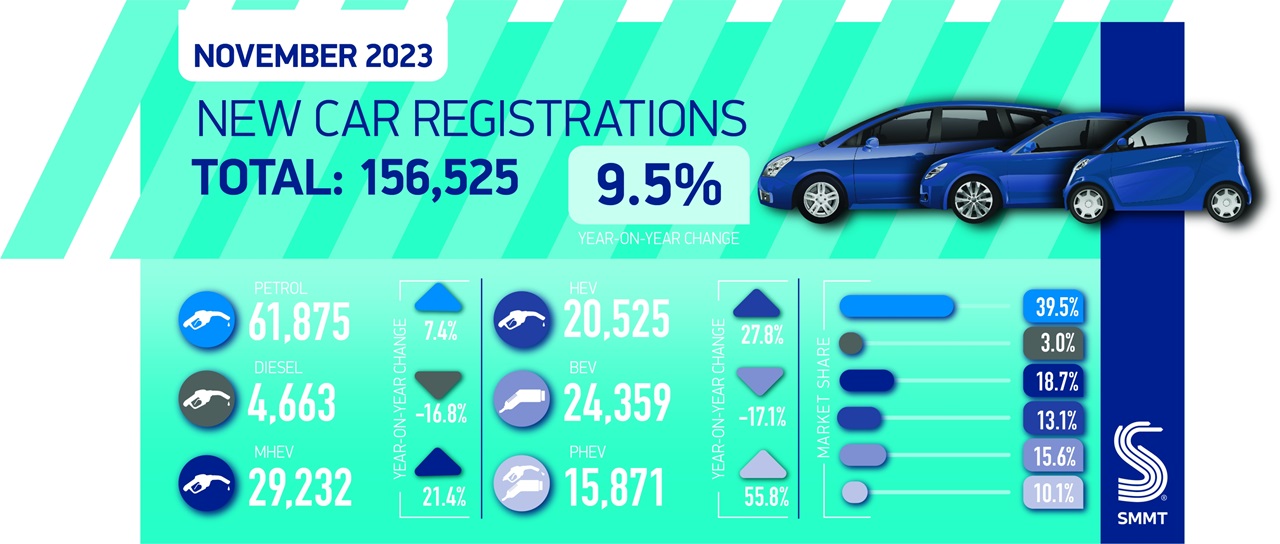
• New car registrations reach 156,525 – up 9.5% on last November and just -0.1% down on pre-pandemic levels.
  • Battery electric vehicle uptake declines compared with bumper month last year, but year to date uptake up 27.5%.
  • Three-year deferral to Rules of Origin needed to avoid EV tariffs and support zero emission transition.

Tuesday 5 December, 2023 The UK new car market grew by 9.5% in November to reach 156,525 units, according to the latest figures from the Society of Motor Manufacturers and Traders (SMMT). In the market’s best November for four years, registrations almost returned to pre-pandemic levels, down just 96 units (-0.1%) on 2019.1

Growth was driven entirely by fleets investing in the latest vehicles, with registrations rising 25.4% to account for 93,049 units and 59.4% of the market. Private demand was depressed, dropping -5.9% to 60,506 registrations, while business uptake fell -32.7% to 2,970 units. Year to date, however, the overall market remains up 18.6% at 1.762 million units, with a return to growth in the corporate market fuelling a recovery that has been underway for 16 months.

November proved a strong month for both hybrid electric vehicles (HEVs) and plug-in hybrid vehicles (PHEVs), rising by 27.8% and 55.8% respectively. Fleets also continued to transition to battery electric vehicles (BEVs), buoyed by compelling tax incentives. Of the 24,359 new BEVs reaching the road in November, 77.4% were taken on by fleets and businesses. While overall BEV volumes fell by -17.1%, leading to a reduced market share of 15.6%, last November was atypical with significant deliveries following supply chain disruptions. Year to date, BEV uptake is up 27.5% with a 16.3% market share – expected to rise to 22.3% next year.2

However, with new regulation coming into force in January mandating that 22% of each manufacturer’s new vehicle registrations must be zero emission, sustained recovery depends on inspiring consumers with fiscal incentives, as well as greater investment in essential charging infrastructure that gives drivers confidence. Halving VAT on new BEVs and reducing VAT on public charging to 5% in line with home charging would increase the attractiveness of driving electric and make the zero emission transition more accessible to a larger number of consumers.

Even more urgent is the need to delay tougher new UK-EU Rules of Origin which will begin on 1 January 2024. Failure to postpone these rules would see EVs traded both ways incur tariffs that would raise prices for consumers at a critical moment in the transition. With less than four weeks to go, carmakers and governments on both sides of the Channel have called for a common sense approach to retain the current EV battery rules for a further three years, which will support consumer choice and affordability.

Mike Hawes, SMMT Chief Executive, said, “Britain’s new car market continues to recover, fuelled by fleets investing in the latest and greenest new vehicles. With car makers gearing up to meet their responsibilities under new market legislation, and COP28 currently underway, now is the time to take sensible steps that will multiply that economic growth and minimise carbon emissions. Private EV buyers need incentives in line with those that have so successfully driven business uptake – and workable trade rules that promote rather than penalise the transition.”

By admin

Leave a Reply

Your email address will not be published. Required fields are marked *

You missed

South West homeowners face seven-day waits for urgent repairs as tradie shortages continue to bite Fix Radio analysis shows the South West is among the slowest regions for urgent fixes, while Plymouth records one of the longest city-level waits in the UK The South West records an average 7-day wait for an urgent tradie fix. Plymouth records one of the longest city-level waits in the dataset, at 10 days. Across the 17 cities surveyed, the average wait for an urgent fix is just over 6 days. CITB says the UK construction industry needs to recruit the equivalent of 239,300 extra workers between 2025 and 2029. Analysis from Fix Radio shows that homeowners in the South West are facing an average seven-day wait for an urgent tradesperson fix, placing the region among the slower parts of the UK for repair response times. Based on Fix Radio’s analysis of city-level urgent repair wait-time data from Markel Direct’s Censuswide survey of UK homeowners, the findings point to continued pressure on trades capacity, local demand and labour availability across the region. The national picture remains highly uneven. The East of England records the shortest average wait at three days, followed by the North East on four days, the North West on 4.5 days and London on five. Wales and the South East each average six days, Yorkshire and the Humber sits at 6.5, while the South West, West Midlands, Scotland and Northern Ireland all come in at seven days. At the other end of the scale, the East Midlands records the longest average delay at nine days, leaving a six-day gap between the fastest and slowest regional averages in the dataset. The research also found that 44% of homeowners have already delayed repairs because of the cost of hiring a tradesperson, while city-level data shows waits stretching as high as 10 days in Plymouth for urgent issues. That makes the South West one of the clearest examples of how regional pressure can build when local demand, household repair needs and labour constraints begin to overlap. Set against a construction workforce already under strain, the figures point to a region where availability remains a growing issue for both customers and tradespeople. CITB forecasts that the industry will need to recruit the equivalent of 239,300 extra workers between 2025 and 2029, with the UK construction workforce expected to reach around 2.75 million by 2029. From Fix Radio’s perspective, the findings reflect a wider story around availability, local demand and the challenge of keeping enough skilled people in the pipeline. Waiting times are not only a sign of homeowner frustration. They also show where order books are full, where capacity is tight and where the wider conversation around skills and recruitment is becoming harder to ignore. In the South West, where regional averages are already above the national benchmark and Plymouth stands out as one of the slowest locations in the dataset, that pressure is becoming increasingly visible. About Fix Radio Fix Radio, the Builders Station is the home of entertainment, music and information for UK tradespeople. Since 2017 the station has been built from the ground-up with tradespeople in mind, providing a mixture of authentic trade voices, up-beat music and a schedule designed around the tradesperson’s day. The station’s schedule includes some of the biggest talent in the industry, including social media influencers the Bald Builders, Clive Holland of the BBC and formerly Cowboy Trap, the country’s most famous plasterer Chris Frediani from DIY SOS, plumbing influencers Andy Cam and Todd Glister, decorators Joel Bardall and Todd Von Joel, electrician turned YouTuber Thomas Nagy, Roofer of the Year Danny Madden, carpenter, craftsman and social media influencer Robin Clevett. Broadcasting nationally on DAB since May 2022, Fix Radio has an average reach of 833,545 tradespeople each week. The Builders Station also boasts 27.9 average weekly listening hours. Fix Radio’s audience reach and listening hours are audited by Nielsen.