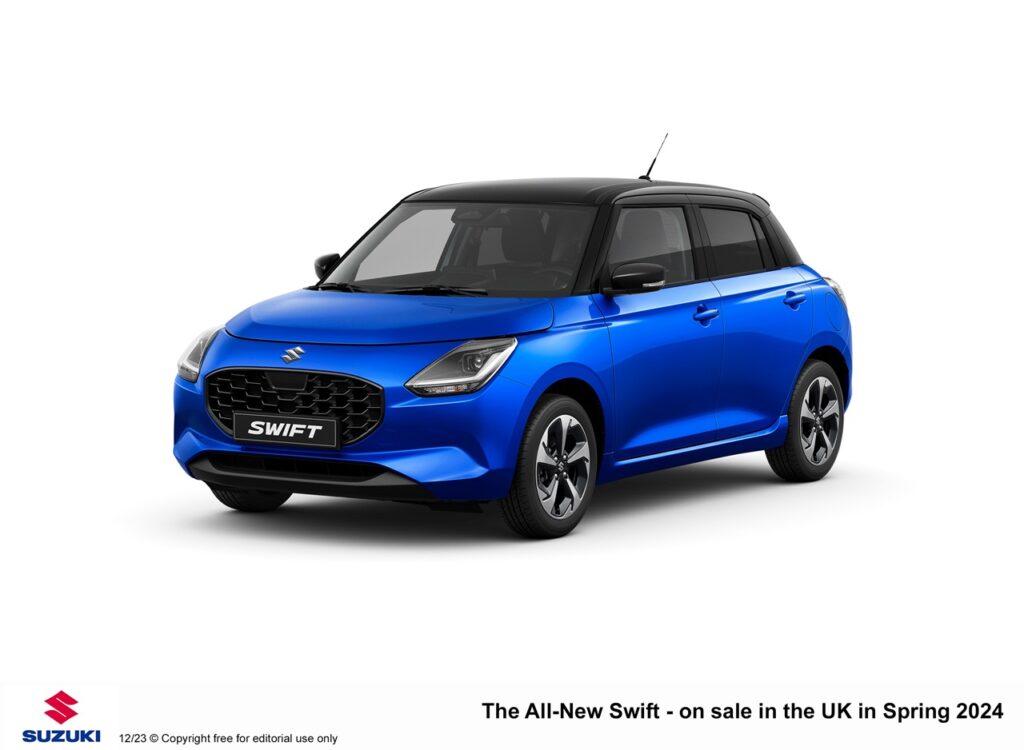
Suzuki has unveiled the all-new Swift. In its fourth iteration, Suzuki’s iconic hatchback has evolved into a sophisticated, smart compact with a crisp design, advanced safety features, and fun-to-drive playfulness that redefines everyday mobility.
A long-time favourite among consumers across the world seeking a stylish and fun-to-drive hatchback, the Swift has won numerous awards since its introduction as a global model in 2004. The all-new model builds upon the legacy of its predecessors, offering a driving experience that is not only enjoyable but also prioritises comfort, efficiency, and safety. The Swift has been sold in 169 countries and regions with accumulated sales of over 9 million units as of October 2023.
The all-new Swift will go on sale in the UK in Spring 2024 and further details regarding technical specification and standard equipment will be provided in due course.
New Swift Highlights
- Dramatic new exterior and interior design
- Advanced safety features
- New 1.2L engine with 12V mild hybrid system
Dramatic new exterior and interior design
While maintaining the signature looks reminiscent of its predecessors, the new Swift has undergone a dramatic redesign beyond the parameters of past models.
Exterior Styling
The new Swift exudes confidence and adventure with a piano-black grille and L-shaped signature lamps that flow into rounded shoulder lines, highlighted by flared fenders.
Side on, the muscular contours tracing the new Swift’s profile, and the floating design of the roof add a sense of energetic lightness.
The three-dimensional rear combination lamps, and wide rear bumper give the new Swift a stable yet playful look that stands out on the road
Body Colours
The new Swift colour line-up consists of eight single-tone options and four dual-tone options, including new colours Frontier Blue Pearl Metallic and Cool Yellow Metallic. Notably, the new Frontier Blue Pearl Metallic joins the Burning Red Pearl Metallic paint scheme as a deep, vivid, candy-like colour tone, symbolising a new era of Suzuki paint quality. Both colour options consist of a three-layer coating, resulting in a rich texture and highly saturated hues.
Interior Styling
The new Swift offers a spacious and comfortable cabin equipped with ergonomic features to elevate the driving experience.
Inside the new Swift is a cockpit designed for an immersive and ergonomic driving experience, featuring a centre cluster and controls that are subtly angled toward the driver to ensure ease of use. The wraparound, dual-tone black and light-grey dashboard and front door trim, with satin plating and satin dark silver paint accents, give the cabin a sporty, dynamic look.
9-inch Display Audio
The 9-inch HD capacitive touchscreen delivers a quick and accurate response. It features smartphone linkage for both Apple CarPlay® and Android Auto™ through Wi-Fi and USB, voice recognition, Bluetooth® music playback, and also displays information about the vehicle’s status.
*Apple, Apple CarPlay, iPhone and Siri are trademarks of Apple Inc., registered in the U.S. and other countries.
*Google, Android, Android Auto and other marks are trademarks of Google LLC.
*Bluetooth is a registered trademark of Bluetooth SIG, Inc
Advanced safety features
Dual Sensor Brake Support II (DSBS II)
Millimetre-wave radar and a monocular camera are employed to detect vehicles, bicycles, and pedestrians in front of the vehicle, and help mitigate frontal, diagonal, and lateral collisions. If a collision seems possible, audio and visual warnings are issued to alert the driver. If the driver brakes with insufficient force, brake assist automatically engages to help slow the vehicle. And if the probability of a collision increases, the system automatically applies brake force to help reduce impact force and mitigate damage.
Lane Keep Assist (LKA)
When adaptive cruise control is activated, the LKA helps the driver maintain the vehicle’s position in the centre of the lane. In addition, if it senses that an adjacent vehicle or structure such as a temporary roadwork barrier or other obstacle is too close to the driver’s vehicle, it provides steering assistance to help maintain a safe distance.
Driver Monitoring System (DMS)
A camera built into the instrument panel monitors the driver’s eyes and face. If the system detects that the driver is drowsy, falling asleep, or looking away from the road, it sounds a warning alarm and displays an alert message on the information display.
Other technological features include:
- Lane Departure Prevention (LDP)
- Adaptive Cruise Control (ACC)
- Traffic Sign Recognition (TSR)
- Blind Spot Monitor (BSM)
- Rear Cross Traffic Alert (RCTA)
- eCall
New 1.2L engine with 12V mild hybrid system
The new 1.2-litre petrol 3-cylinder engine in the new Swift features improvements all around, combining enhanced fuel economy and reduced emissions, with higher low-speed torque for greater responsiveness and overall performance.
In the new Swift, the engine is paired with the mild hybrid system for further enhanced environmental performance. The hybrid system converts kinetic energy generated during deceleration, and stores it in the lithium-ion battery, and assists the engine when accelerating for higher fuel efficiency.
ALLGRIP AUTO
ALLGRIP AUTO is an automatic four-wheel drive system that engages when it detects a loss of front wheel traction. When front-wheel slippage is detected, a viscous coupling engages to transfer torque to the rear wheels, providing additional traction for driving on snow-covered roads or other slippery surfaces.
SUZUKI CONNECT
SUZUKI CONNECT utilises the vehicle’s data communication module (DCM) to connect users to their vehicles in real time, enabling users to take advantage of convenient functions via the SUZUKI CONNECT smartphone app. For added convenience, some SUZUKI CONNECT functions are now available via the 9-inch display audio screen inside the new Swift.
Major functions:
- Status notification
- Parked car locator
- Driving history
- Geofencing and curfew alert
- Security notification
- Warning light notification
- Periodic maintenance / Recall notification