
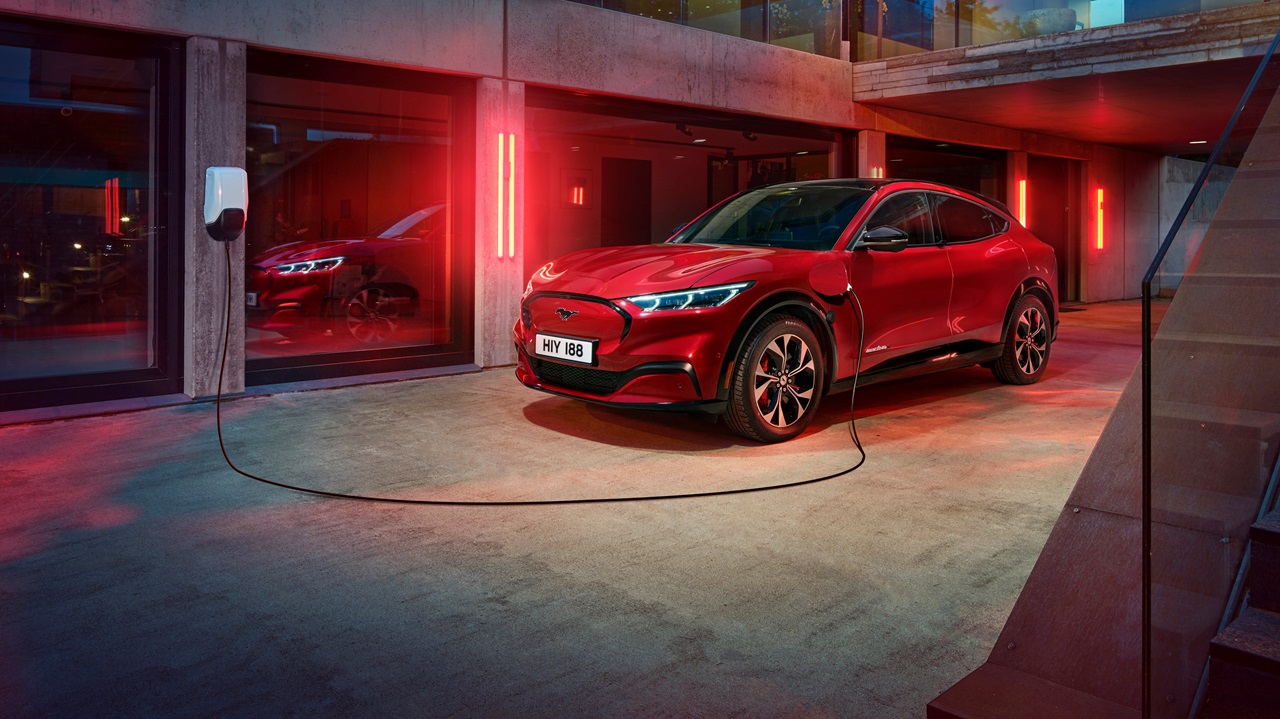
- Energy industry disruptors Octopus Energy in Great Britain and Tibber in Germany, the Netherlands and Norway to support new Ford EV charging initiative
- New Ford Dynamic Charging enables access to innovative tariffs for at-home charging that can save on electricity costs and optimise use of electricity from renewable sources for Ford EVs starting with Mustang Mach-E from early 2024
- Research shows energy cost is the top priority for Mustang Mach-E owners. Cloud-connected tech will also enable next-gen smart charging for electric Ford Explorer
COLOGNE, Germany, Nov. 30, 2023 – Ford today announced that maximising the convenience and cost-savings of the company’s expanding range of electric vehicles (EVs) – as well as optimising the use of electricity from renewable sources 1 – is about to get even easier.
New energy experiences delivered in partnership with industry innovators Octopus Energy in Great Britain and Tibber in Germany, the Netherlands and Norway, will enable Ford customers to charge their EVs using energy tariffs specifically designed to enhance the ownership experience.
Developed to support Ford’s expanding EV line-up, the opportunities will initially be available from early 2024 to drivers of Ford Mustang Mach-E, 2,3 followed by the new Ford Explorer 4 when it arrives later in the year.
A newly developed Dynamic Charging feature is designed to enable Ford EVs to communicate with the energy providers’ intelligent supply networks. As a result, owners of compatible models will be able to plug in their vehicle, input their desired state-of-charge and departure time using a smartphone app and simply get on with their day – safe in the knowledge that their battery will be automatically charged using tariffs designed to maximise cost savings and the use of renewable energy. 1
“Our new energy initiative is another milestone on our journey to offer a new generation of all-electric vehicles built for a connected world while providing truly outstanding customer experiences,” said Martin Sander, general manager, Ford Model e, Europe. “We’ve specifically chosen to work with energy providers that share our disruptor mindset and that customers can rely on to deliver leading rates for charging with renewable electricity, so that their EV will be ready to go when they are.”
Ford research indicates up to 87 per cent of Mustang Mach-E drivers charge their vehicle at home, and that the cost of energy used is the most significant consideration when charging.
Depending on market, Ford’s new energy services have the potential to benefit EV owners whether charging during day or night. The connected technology can automatically optimise charging to make use of cheaper off-peak electricity at night, and lower energy prices created by peak supply of renewable energy including solar during the day. 1
In Great Britain, Octopus Energy’s energy services business, Octopus Energy Services, will be the preferred installer of Ford customers’ home charge points.
“With every electric car that takes the road, we’re getting closer to zero emissions transport – but to reach the finish line, we need to make green driving cheap and accessible,” said Michael Cottrell, partnerships director at Octopus Energy. “Our smart tariffs allow drivers to tap into cheap renewable power, potentially saving drivers hundreds of pounds a year while doing their bit for the planet.”
Ford customers in Great Britain who are interested in a home charger installation can visit www.ford.co.uk/hybrid-electric/charging/home-charging to learn more.
According to Tibber, more than one million users have already actively used the company’s platform to change their energy behaviour.
“As the pioneers of smart charging in Norway and Germany, we are excited about this new partnership with Ford,” said Børge Dvergsdal, manager, Smart Charging, Tibber. “We are impressed with Ford’s ambitions and have a shared mission to empower consumers to use energy more smartly. To do so, consumers need the best tools available to take control of their energy consumption effectively, and our collaboration will offer consumers a seamless charging experience to the benefit of their wallet and the planet. We look forward to welcoming Ford customers to the Tibber universe.”
Ford will offer ten electric vehicles in Europe by 2025, including Explorer, Mustang Mach-E, F-150 Lightning, 4 Puma, 4 E-Transit, 5 E-Transit Custom, 6 E-Transit Courier, 4 E-Tourneo Custom, 7 E-Tourneo Courier 4 and a further mid-size crossover, and plans to roll out its energy services to further electric products through 2024 and beyond.
The company last year announced that it will shift its entire line-up of passenger and commercial vehicles in Europe to 100 per cent electric by 2035.
Ford is also targeting carbon neutrality across its European footprint of facilities, logistics and direct suppliers by 2035; plans for more than half its global production to be EVs by 2030; and is targeting carbon neutrality globally no later than 2050.
Earlier this year, Ford opened the Ford Cologne Electric Vehicle Center (CEVC), Germany. The facility will produce a new generation of electric passenger vehicles for European markets, starting with the new Ford Explorer. CEVC will be Ford’s first carbon neutral vehicle assembly plant globally, an important milestone on the Road to Better.