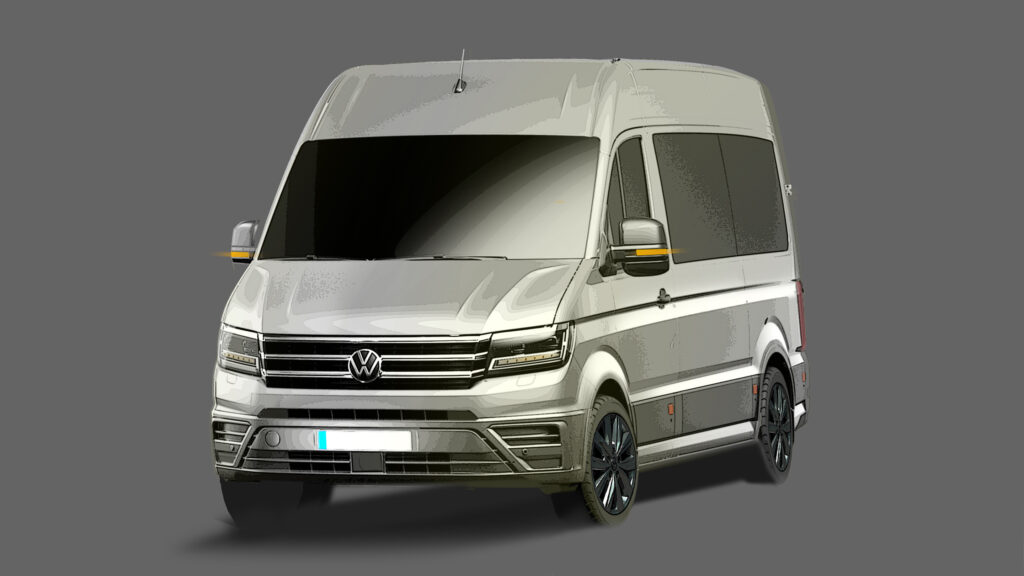
- Second-generation Crafter with over 354,000 vehicles sold receives extensive technical update comprising a new cockpit landscape and new assist systems
- New infotainment system with free-standing display offers intuitive operation, state-of-the-art apps and a high degree of individualization
- New Digital Cockpit, new electronic parking brake for more space when moving around the vehicle, new multifunction steering wheel and new selector lever as in the ID. Buzz
- Pre-sales of the new Crafter are scheduled to start in Europe in April next year, followed by markets such as Australia, New Zealand, South Africa and South America
The Crafter is one of the most modern commercial vehicles in its segment. More than 354,000 units of the current generation were sold up to the end of last year alone. The Crafter impresses – whether as a panel van, dropside, chassis, Grand California camper van or as a platform for second stage manufacturers. Volkswagen Commercial Vehicles is now presenting the first facts about a far-reaching technical update of the Crafter. The software and hardware are being upgraded to a new level. The cockpit landscape in particular has been completely redesigned. The Crafter is equipped with the latest generation of infotainment systems. Also new: the Digital Cockpit, multifunction steering wheel, an electronic parking brake and numerous assist systems. Pre-sales of the new Crafter start in April 2024.
Statements: Karsten Franz, Head of Technical Development at Volkswagen Commercial Vehicles, said: “We have updated the Crafter’s electronics architecture to integrate the next-generation infotainment, assist and convenience systems into the successful model. This means the Crafter will remain the most advanced commercial vehicle model series in its class.”
Chief Designer Albert Kirzinger adds: “The Crafter sets itself apart with a timeless, high-quality and clear design. However, it also sets standards for practical use right from the start. We have therefore deliberately focused on revamping the interior. The result is a intuitive state-of-the-art cockpit landscape that reflects modern times and makes the driver’s everyday work easier.”
New infotainment system: The defining interior detail of the 2024 Crafter is a now 10.3-inch and optionally 12.9-inch infotainment display based on the latest modular infotainment matrix (MIB). It has been arranged to be visually free-standing. The Volkswagen system features a newly developed graphic interface and selfexplanatory menu navigation, as was presented for the first time this summer for the new long-wheelbase ID. Buzz. The display has been divided into two permanently visible touch bars and the home screen. On the left of the top bar on the display, there is a new direct access button, which enables the driver to open the main menu with an overview of all apps with just one click. Next to this is a button for the new Car Control Centre, which offers direct access to the most important vehicle functions. The main menu and Car Control Centre are always accessible without having to close the active app. This makes operation easy. The new home screen in the middle combines the content of the most important apps on differently sized tiles; the apps can be individually configured. The bottom touch bar contains the air conditioning and seat heating functions and has a home button that allows the driver to return to the central home screen at any time. The temperatures and audio volume can now be adjusted by means of illuminated touch sliders. The Crafter will also receive a new online voice control system that responds to natural voice commands.
New digital instruments: The new Crafter will be available with digital instruments for the first time: the Digital Cockpit is standard equipment. Using a separate View button in the likewise new multifunction steering wheel, the driver can select different views and thus also individually adapt this display. In addition to central displays such as speed or range, many other menus and information displays are available in each view – from navigation and telephone through to the media library. They are also controlled using the buttons on the new multifunction steering wheel.
New electronic controls: The handbrake and the switch for the eight-speed automatic gearbox have also been redesigned. Whereas the Crafter previously had a traditional handbrake lever next to the driver’s seat, the new generation will be equipped with an electronically operated parking brake whose switch is located between the instruments and the infotainment system. This frees up the space next to the driver’s seat and improves access to the rear, making it easier – especially in camper vans – to operate a driver’s seat that can be rotated by 180 degrees. The selector lever is now designed as a steering column switch in the style of the ID. Buzz. Vehicles with a manual gearbox will retain the gearshift in the centre console, while Crafter models with automatic gearbox will in future have a compartment for drinks there. The controls for the light functions, button panels in the area of the centre console and all air vents have also been redesigned and relocated. Instead of USB-A sockets, the new Crafter now has USB-C interfaces and an inductive charging option for smartphones. Another new feature is a USB-C charging port in the centre of the upper windscreen trim. This interface enables the use of customer-specific devices in the area of the windscreen without disturbing cables interfering with the driver’s or front passenger’s field of vision.
New assist systems: Volkswagen Commercial Vehicles will greatly expand the array of assist systems. New and standard on vehicles with a gross vehicle weight of more than 3.5 tonnes (N2): a blind spot information system that alerts the driver to pedestrians and cyclists or scooter riders who are in the blind spot to the side of the Crafter when driving in urban traffic (0–30 km/h). Also new and standard for the models over 3.5 tonnes: a moving-off information system (informs the driver when moving off whether there are any pedestrians in front of the Crafter) and an oncoming vehicle braking when turning function (brakes in the event of oncoming traffic). These systems can be ordered as an option for vehicles with a gross vehicle weight of up to 3.5 tonnes (N1). Always standard in future: Front Assist (Autonomous Emergency Braking including cyclist and pedestrian detection), Lane Assist (lane keeping system), Dynamic Road Sign Display, a speed limiter and acoustic Park Distance Control for the rear area. Travel Assist will be available as an option for the Crafter for the first time. Here, Adaptive Cruise Control ACC (automatic acceleration and braking) and Lane Assist are merged into one system that increases convenience and safety, especially on long journeys, thanks to assisted longitudinal and lateral guidance. In combination with Travel Assist, Emergency Assist (automatic braking and manoeuvring to the edge of the road until standstill) is now also introduced in the Crafter. The range of new standard and optional assist systems raises the product line to a new level and thus makes everyday work easier for Crafter drivers.
With range of model versions: Once again, the Crafter will be available with a wide range of body types – one of the major strengths of this model series. The spectrum ranges from closed panel vans through to single and double cabs as dropsides and chassis as well as box bodies and tippers. In addition, there will again be different weight classes (up to 5,500 kg gross vehicle weight), two wheelbases (3.64 and 4.49 metres) and various overall lengths (6.0 to 7.4 metres). As before, Volkswagen Commercial Vehicles will offer the Crafter with four roof heights (2.4 to just under 3.0 metres). The new Crafter will also be available with front-wheel, rear-wheel and all-wheel drive. In addition to the familiar six-speed manual gearbox and eight-speed automatic gearbox for the front-wheel and all-wheel drive models, a new eightspeed automatic gearbox will be used for the variants with rear-wheel drive. The efficient and high-torque four-cylinder turbocharged diesel engines will once again deliver 103 kW (140 PS), 120 kW (163 PS) and 130 kW (177 PS). The range of registration options is also being expanded – either as light duty (emission and consumption values are determined analogous to measurement methods used for passenger cars) or heavy duty (emission and consumption values are determined by engine test bench and consumption test drive according to the WLTP cycle). In this way, Volkswagen Commercial Vehicles can meet an endless number of customer and body requirements.