
- First Hyundai model to feature Intelligent Front-lighting System (IFS)
- IFS prevents dazzling effects from the high beam for other road users, while securing clear visibility for the driver
- Over 700 parametric pixels reinforce the IONIQ brand’s identity throughout the vehicle
Offenbach, 20 March 2023 – Hyundai Motor recently launched IONIQ 6, the second model in its IONIQ line-up brand dedicated to battery-electric vehicles (BEVs). The Electrified Streamliner has an aerodynamic profile for outstanding efficiency and makes innovative use of sustainable materials to reflect EV customers’ values. IONIQ 6 is also equipped with an array of advanced technologies, personalised space and features, while offering an extended range, to redefine the boundaries of electric mobility.
For the first time in a European Hyundai model, IONIQ 6 features a state-of-the-art Intelligent Front-lighting System (IFS) with Matrix Beam LED headlights, which change depending on the road situation. IFS features an automatic function, which partially turns off the high beam lights that disrupt other drivers when a car is detected in front or on the opposite side of the road. This supports safer driving at night, as the high beam lights don’t have to be adjusted manually to avoid dazzling other drivers.
The evolution of High Beam Assist
IFS could be considered as an evolved form of the HBA (High Beam Assist) active safety feature, which also works to avoid diminishing other road users’ visibility at night. A standard HBA works by temporarily disabling the high beam once it detects a vehicle in front or approaching from an opposite lane. But because it turns off the high beam entirely, it results in a temporary reduction in the driver’s visibility, even if only for a few seconds.
IFS, on the other hand, successfully addresses this issue. Like HBA, it keeps the high beam on perpetually. Once it detects vehicles ahead, it turns off only the parts of the high beam lights that would disrupt the other driver(s) vision. Therefore, IFS means that maximum visibility for the IONIQ 6 driver’s remains at any time.
Efficient innovation in headlamp technology
High-beams are often considered a double-edged sword: While they ensure the visibility of the driver who uses them, the added visibility often comes at a sacrifice of the driver from the oncoming car or car in front, who may be blinded by the powerful stream of light.
IFS, though, comes with the partial light control capability that prevents such dazzling effects from happening, ensuring the highest visibility without inconveniencing other drivers.
IFS technology is applied to the high beam module in each of IONIQ 6’s signature Parametric Pixel lamps. Each high beam module contains a Matrix Beam LED, which aligns 8 IFS segments per lamp in a row and therefore can offer high, concentrated visibility. Thanks to this diversification of light sources, IFS can precisely control the direction and the intensity of light beams.
The light waves generated by the Matrix Beam LED are subjected through two special lenses that control the beam patterns. The optic lens positioned directly in front of the light source creates rectangular matrix beam patterns.
These patterns then go through the freeform lens, which projects the light onto the road in front of the car. The powerful lights from the IFS’s efficient LEDs would be in vain if not for the assistance from these optical structures.
Securing everybody’s visibility
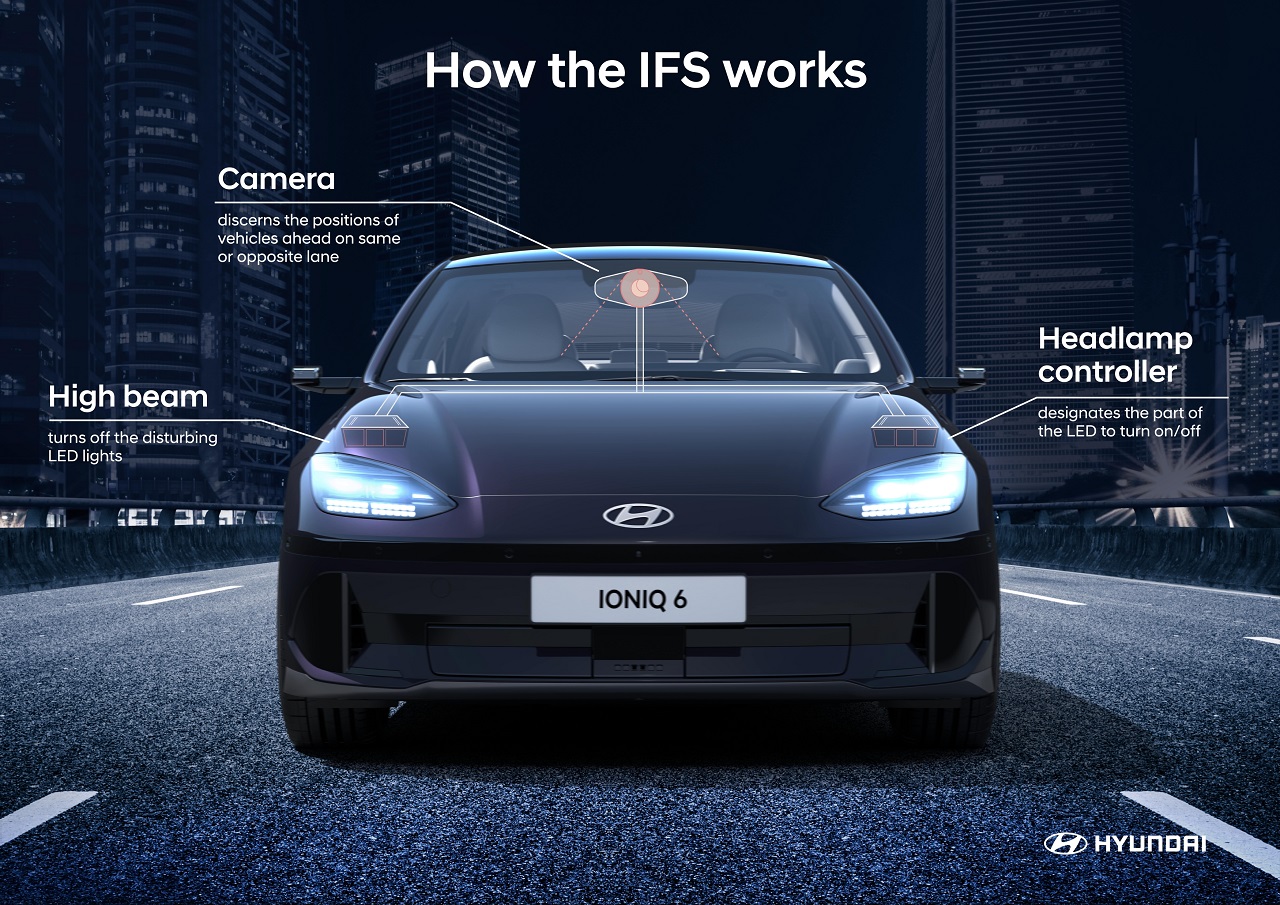
Broadly speaking, the IFS functions in three steps. First, the forward-facing camera in the top of IONIQ 6’s windshield detects the position of vehicles ahead and sends the location and angle info to the headlamp controller. Second, the headlamp controller calculates the ‘disturbance zone’ in which the other drivers’ visibility will be diminished and designates the corresponding LED lights among the headlights’ 16 IFS segments.
Finally and last, the high beam module turns off the corresponding segments designated by the headlamp controller, leaving the rest of them on. The result: constant, clear visibility is secured for the driver of IONIQ 6, and a dazzling effect from the high beam is prevented for other road users.
Signature IONIQ pixels
Like Hyundai’s award-winning IONIQ 5 before it, IONIQ 6 implements the Hyundai Look design strategy that gives each model a unique appearance, like chess pieces. It integrates over 700 Parametric Pixels in numerous places, such as headlamps, rear combination lamps, front lower sensors, air vent garnishes and centre console indicator, to reinforce the brand’s identity throughout the vehicle. Implemented in every IONIQ model, the Parametric Pixel links the digital and the analogue eras to connect generations towards an all-electric future.
The rear wing’s Parametric Pixel High-Mounted Stop Lamp (HMSL) delivers an eye-catching light execution when the brakes are applied. To further highlight IONIQ 6’s uniqueness, the newly designed Hyundai flat-type ‘H’ badge is applied on the front and rear of the vehicle.